Sometimes They Stay
In the next chapter of Stories From The Paramedic Underground, The Paramedic Hive steps once again into the shadows of emergency medicine — where exhaustion blurs reality, where the dead are sometimes said to linger, and where certain calls seem to follow crews long after the shift should have ended. This is not the polished version of EMS seen in recruitment posters and television dramas. This is the darker side of the job — the urban legends, the unexplained encounters, and the uneasy feeling that some scenes never truly let you leave.
Stay safe. Head on a Swivel!
Sometimes They Stay
The first time they saw him again, nobody said a word.
Paramedic Daniel Mercer noticed it while backing the ambulance into Bay 3 just before dawn. A man stood at the far end of the apparatus floor near the wash rack, soaked from the rain, hands hanging loosely at his sides.
Dark jacket. Jeans. Blood down one sleeve.
Daniel blinked.
The figure was gone.
He told himself he was tired.
Three nights earlier, his crew had worked a fatal rollover on Interstate 15 involving a pickup truck that had been crushed beneath a cement hauler. The driver—a thirty-eight-year-old father named Eric Vance—had still been conscious when they arrived.
Barely.
The dashboard had collapsed across his pelvis and abdomen. There was blood everywhere. The steering wheel sat at an impossible angle. Engine 12 had spent twenty minutes cutting him free while Daniel and his partner, Alicia Navarro, fought to keep him alive inside the wreckage.
Eric had grabbed Daniel’s wrist at one point with shocking strength.
“Please,” he whispered through bubbling blood. “Don’t let them die.”
Daniel remembered leaning closer.
“Who?”
But Eric’s eyes had already drifted away.
He arrested during extrication.
They got pulses back once for less than a minute before losing him again five blocks from Mercy General.
Traumatic arrest. Non-survivable injuries.
One more report. One more family notification. One more face added to the collection paramedics carried whether they admitted it or not.
But then things started happening.
Small things at first.
The cardiac monitor would power on by itself during post-shift cleaning. Cabinets inside the ambulance would unlatch after being secured. Twice, Alicia swore she heard someone whispering in the patient compartment while the rig sat empty behind the station.
Not random sounds.
Words.
“Please…”
Then came the calls.
A welfare check for an elderly woman who insisted a wet man had been standing in her hallway staring at family photographs.
A psychiatric call where a child calmly told Daniel, “The bloody man behind you says you forgot.”
An overdose where the radio in the ambulance burst into static before a voice slipped through underneath dispatch traffic:
“Lake Road…”
Daniel jerked upright from the captain’s chair.
“What did you say?”
Dispatch came back confused.
“Medic 42, repeat?”
Alicia stared at him from the airway seat.
“I heard it too.”
Neither of them slept much after that.
Over the next two weeks, the sightings continued.
Always brief.
Always Eric.
Standing at the edge of scenes. Reflected in the ambulance mirror. Visible for half a second in darkened ER hallways before disappearing around corners that led nowhere.
Never threatening.
Never speaking directly.
But always trying.
One night after clearing a chest pain call, Alicia finally snapped.
“This isn’t PTSD anymore.”
Daniel didn’t answer.
Because deep down, he knew she was right.
The turning point came during a thunderstorm just after 0200 hours.
Medic 42 had been posted near the industrial district when every radio in the cab exploded with static simultaneously. Not dispatch interference. Not signal degradation.
Pure white noise.
Then came the voice.
Clear enough for both of them to hear.
“Lake Road.”
Alicia’s face drained of color.
“That’s impossible.”
Dispatch hadn’t transmitted anything.
The MDT remained blank.
But Daniel was already turning the wheel.
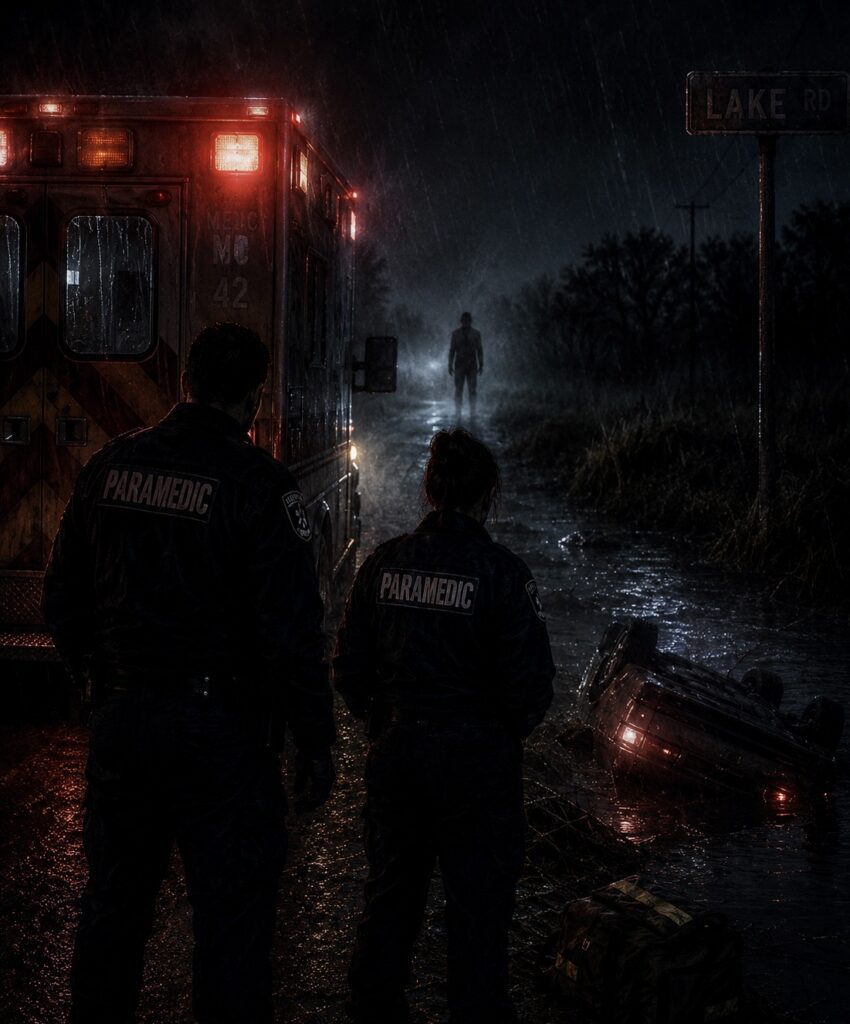
Lake Road sat nearly abandoned at night—a narrow stretch of asphalt winding through old flood channels and scattered mobile homes on the outskirts of the county. No active calls were pending there.
Rain hammered the windshield as they rolled deeper into the darkness.
Then Alicia saw it.
Headlights.
Upside down.
Half-submerged beyond a collapsed guardrail.
“Holy— stop the rig!”
The SUV had rolled nearly thirty feet into a drainage canal hidden by floodwater and brush. They never would have seen it from the roadway.
Engine off.
Windows cracked.
Water rising inside.
Daniel called the incident while Alicia scrambled down the embankment with a trauma bag. A woman inside the vehicle was unconscious against the steering wheel while two terrified children screamed in the back seat as water climbed toward their shoulders.
The rescue became chaos.
Glass breaking.
Mud.
Rain.
The current pulling against them as they dragged the family free seconds before the SUV shifted deeper into the canal.
The youngest child—a little girl around six—clung to Alicia while sobbing uncontrollably.
“My daddy told us you were coming.”
Alicia froze.
“What?”
The little girl pointed toward the roadway above them.
Daniel turned instinctively.
A man stood beside the ambulance beneath the flashing red lights.
Dark jacket.
Jeans.
Blood down one sleeve.
Eric Vance.
For the first time since the wreck, he looked calm.
Not broken.
Not frightened.
Just tired.
He met Daniel’s eyes for one long second.
Then nodded once toward the children being loaded into the ambulance.
And vanished.
The storm seemed quieter after that.
In the following weeks, the activity stopped completely.
No voices.
No shadows.
No figures in mirrors or hallways.
Nothing.
Daniel eventually pulled the original PCR from Eric’s fatal crash while finishing charts late one night. He dug deeper into the demographics section until he found the emergency contact information.
Spouse.
Two children.
Address:
Lake Road.
He sat there staring at the screen for a long time.
Then quietly closed the laptop.
Some calls stayed with you because they went badly.
Others stayed because, somehow, impossibly, they didn’t.
And to this day, whenever heavy rain hits the station after midnight, Alicia still checks the far end of the apparatus bay before climbing into the ambulance.
Just in case someone is still trying to make it home.